Twelve different engines.
Not one.
Acne isn't dryness. Hormonal cycles aren't travel skin stress. So why would one scoring system serve all of them? Each Skin Map runs on its own mathematical engine — different formulas, different weights, different signals. This page shows you all twelve, with the actual function names from the codebase.
A generic "skin score" is fast to build but scientifically dishonest. The signals that explain oily breakouts are not the signals that explain cabin-air dehydration on a long-haul flight, and neither overlap meaningfully with cyclical hormonal flares. So we built twelve focused engines instead of one blurry one — each tuned to a specific question, each transparent enough that you can see the math, each producing a report that actually answers your question.
The shared 4-step pattern
What every map does share is the high-level shape: input → engine → report → next step. The engines themselves are completely different.
Input
You answer 15–30 quiz questions per map. Each question is a science-backed signal: sleep, sebum, climate, sensitivity, hormones, behavior.
Map-specific engine
Your answers run through that map's own scoring logic — different formulas, different weights, different signals. Acne ≠ Dryness ≠ Hormone.
Personalized report
We turn the math into a readable story: hero score, sub-scores, why-this-matters panels, and a recovery curve where relevant.
Connected next step
Each report routes you to the most relevant Skin Map next, so the system grows with you instead of restarting every time.
The twelve engines, in detail
Each card below shows the actual scoring logic from the codebase — function names, weights, and outputs. This is the math, not marketing copy.
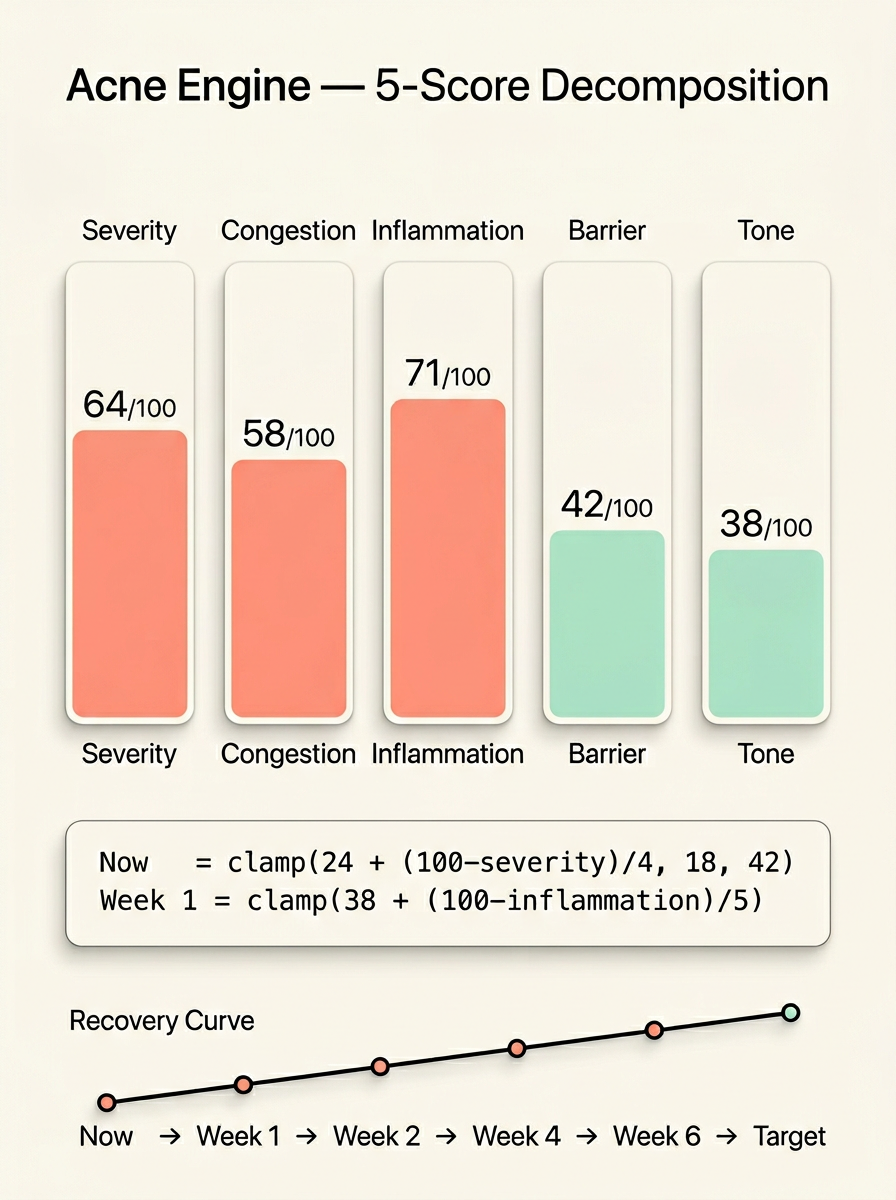
Acne Engine
5-score decomposition with a recovery-curve projection
The Acne engine doesn't just score severity — it decomposes acne into five independent axes: Severity, Congestion, Inflammation, Barrier, and Tone. Each runs on its own logic so the report can tell you what's actually driving your breakouts, not just how bad they look.
The recovery curve uses a real clamped formula: Now = clamp(24 + (100−severity)/4, 18, 42). Better severity scores mathematically push the starting point of recovery higher, so the curve isn't fictional — it's tied to your actual inputs.
5 scores · pattern type · 6-week recovery curve · top-3 product matches by market
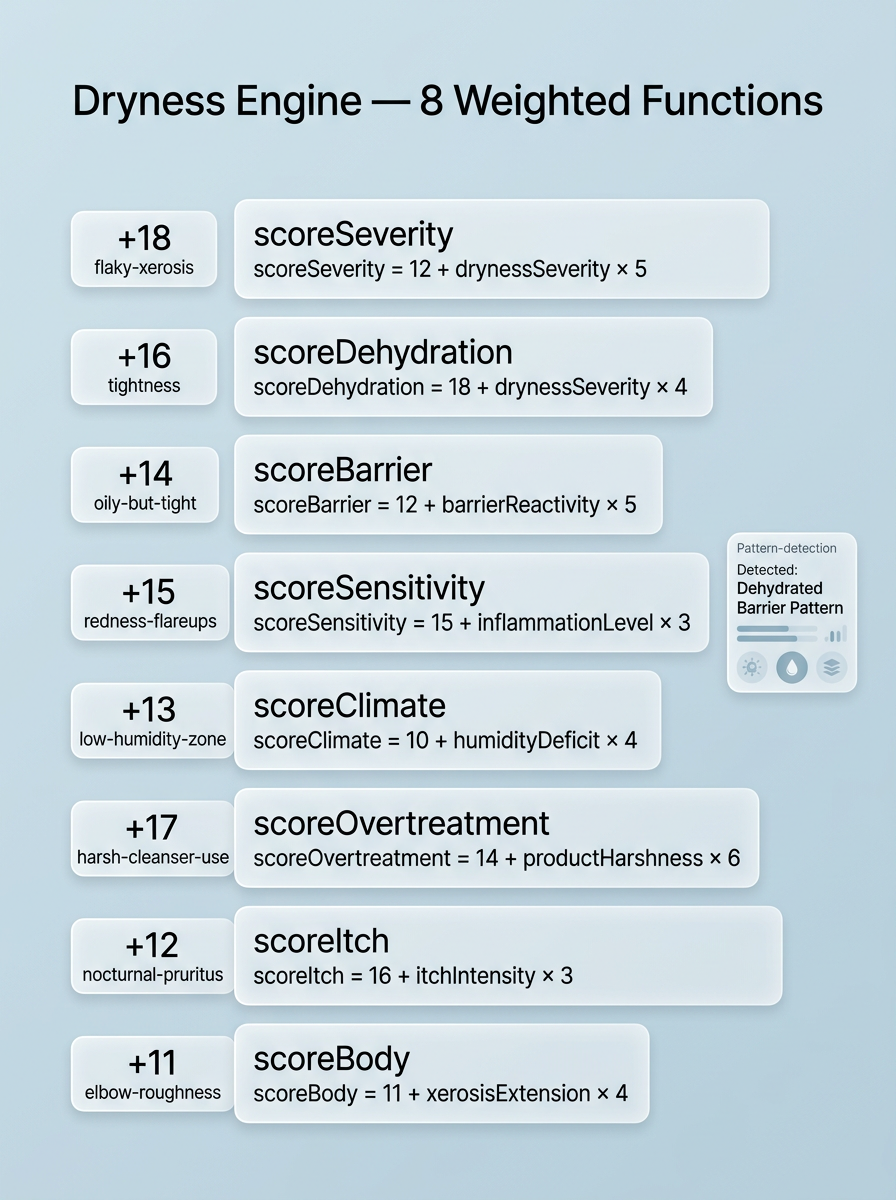
Dryness Engine
Eight transparent weighted functions — the most explainable engine
Dryness has the most transparent math of any engine in the system. Every score starts from a base value and adds explicit weighted increments for each signal you give it.
For example: scoreSeverity = 12 + drynessSeverity × 5, then +18 if pattern is flaky-xerosis, +16 if visible flaking, +12 if post-cleanse tightness. Nothing is hidden — you could rebuild your own score on paper if you wanted to.
8 sub-scores · pattern detection · ingredient highlights · projected recovery
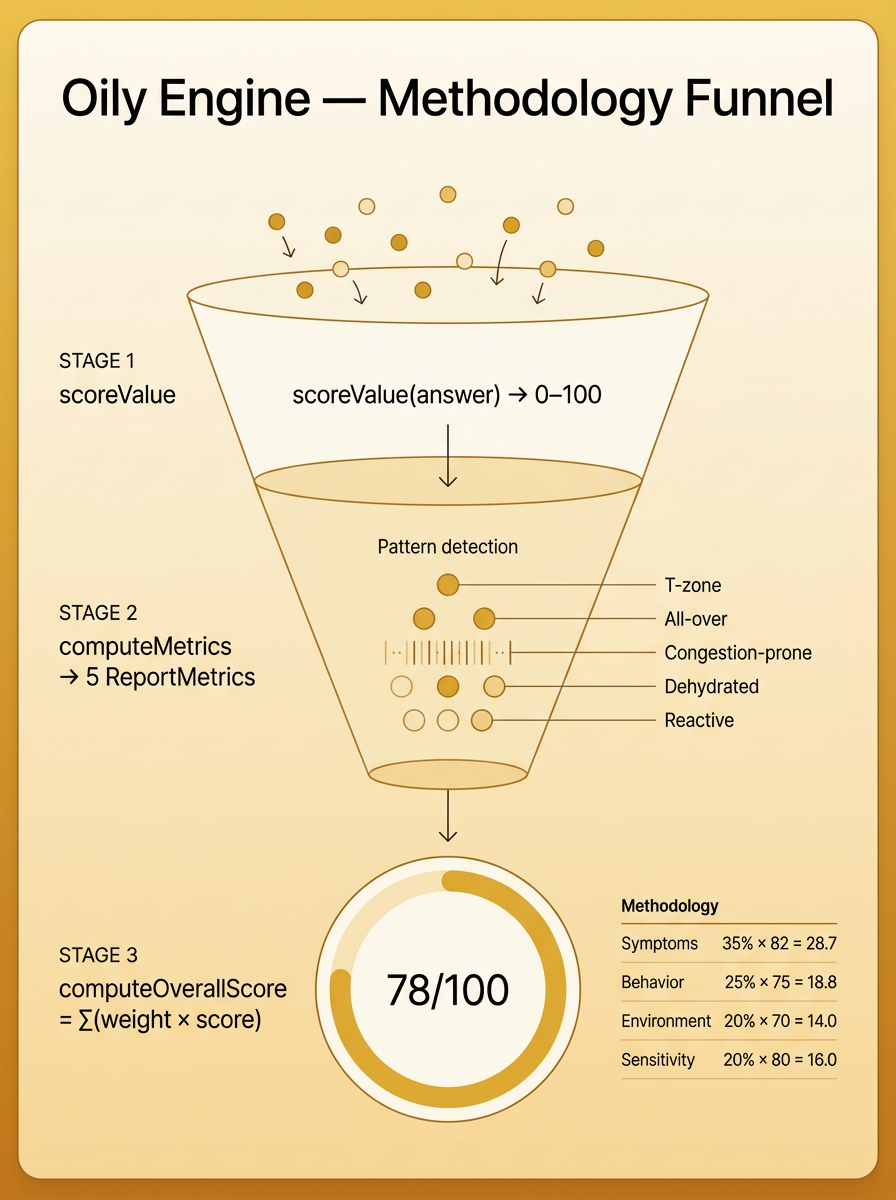
Oily Engine
A three-stage methodology funnel from raw answers to weighted total
The Oily engine flows through three sequential stages: each answer is first normalized to 0–100 by scoreValue, then aggregated into pattern metrics by computeMetrics, then summed against section weights (Symptoms, Behavior, Environment, Sensitivity) to produce a final overall score.
It detects five oily-skin patterns — T-zone, All-over, Congestion-prone, Dehydrated, Reactive — and shifts product weights based on which one wins.
5 metrics · pattern winner · methodology table · routine intensity
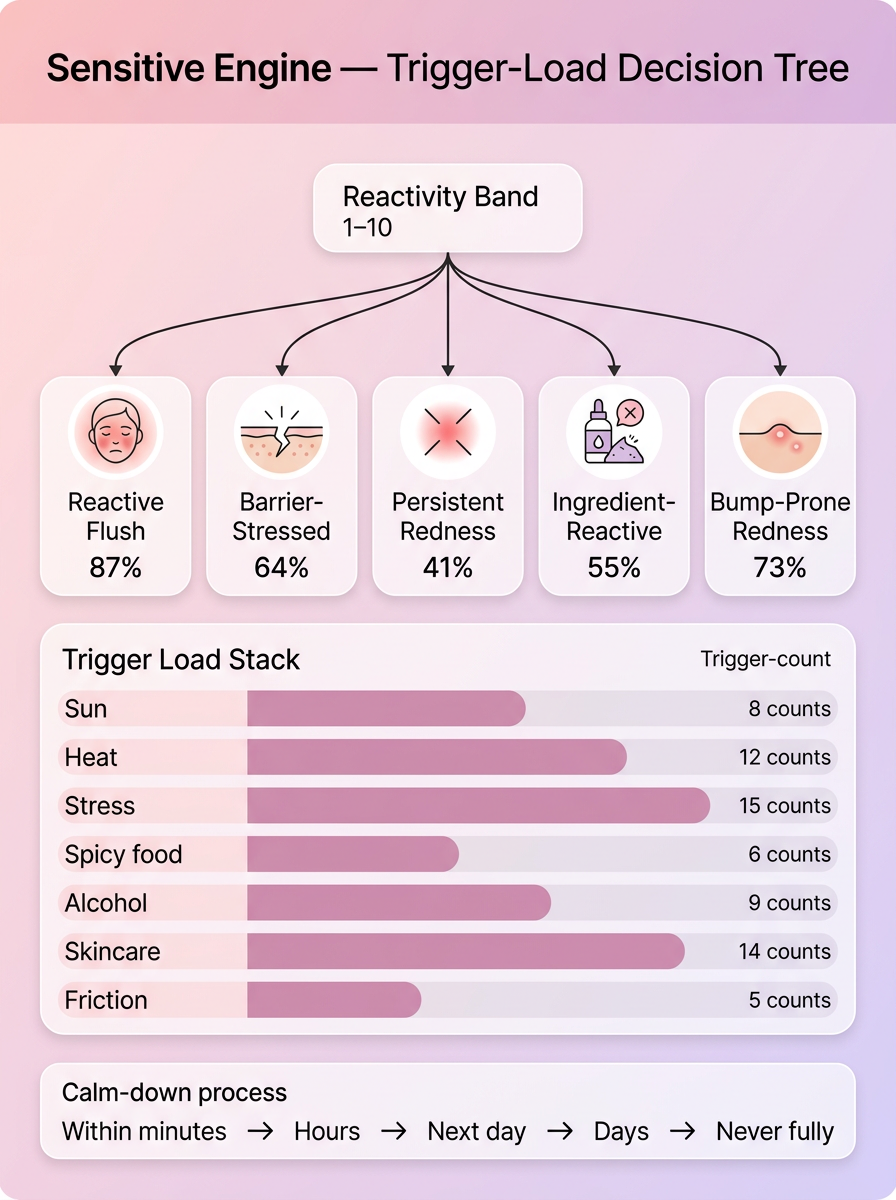
Sensitive Engine
A trigger-load × reactivity decision tree across five patterns
Sensitivity isn't one thing — it's at least five distinct patterns, and the engine has to pick which one is most likely yours: Reactive Flush, Barrier-Stressed, Persistent Redness, Ingredient-Reactive, or Bump-Prone Redness.
It does this by combining your reactivity band (1–10) with your trigger-load stack (sun, heat, stress, spicy food, alcohol, skincare, friction) and your calm-down timeline — anywhere from minutes to never-fully-resolved.
Pattern classification · trigger map · barrier-load score · calm routine
Hormone Engine
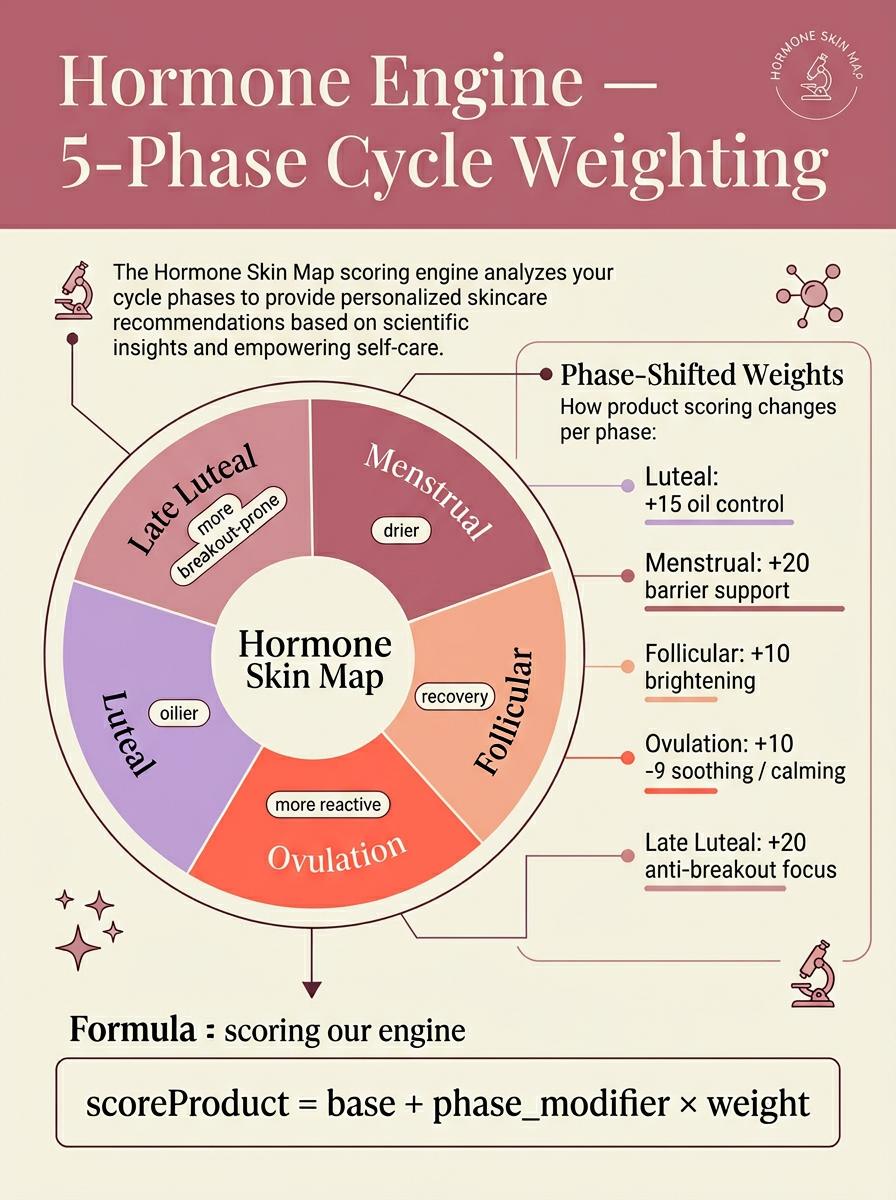
Phase-shifted product weighting across the five-phase cycle
Most skincare engines ignore the single biggest variable in cyclical skin: where you are in the cycle right now. The Hormone engine doesn't.
It uses the formula scoreProduct = base + phase_modifier × weight across the five cycle phases — Menstrual, Follicular, Ovulation, Luteal, Late Luteal. So the same person gets different product priorities in different weeks, because their skin literally is different.
Phase-by-phase routine · cycle tracker · top product picks per phase
Pigmentation Engine
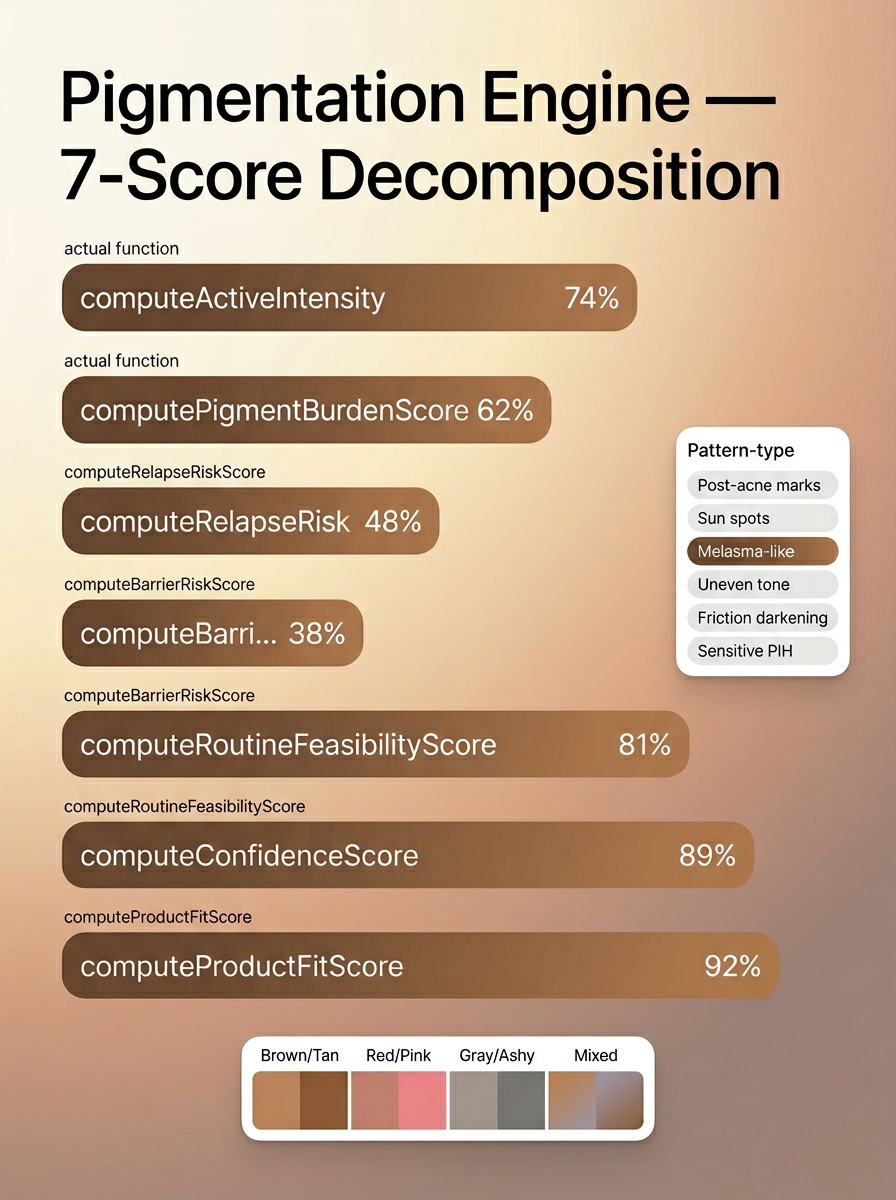
Seven independent risk and burden scores plus product-fit ranking
Pigmentation isn't just how dark the marks are — it's also how likely they are to come back, how stressed your barrier is, and whether your routine is realistically doable. The engine separates all of this into seven distinct scores.
Function names from the actual codebase: computeActiveIntensity, computePigmentBurdenScore, computeRelapseRiskScore, computeBarrierRiskScore, computeRoutineFeasibilityScore, computeConfidenceScore, computeProductFitScore.
7 sub-scores · color-tone matrix · pattern winner · gentle vs aggressive routine track
Beauty Engine
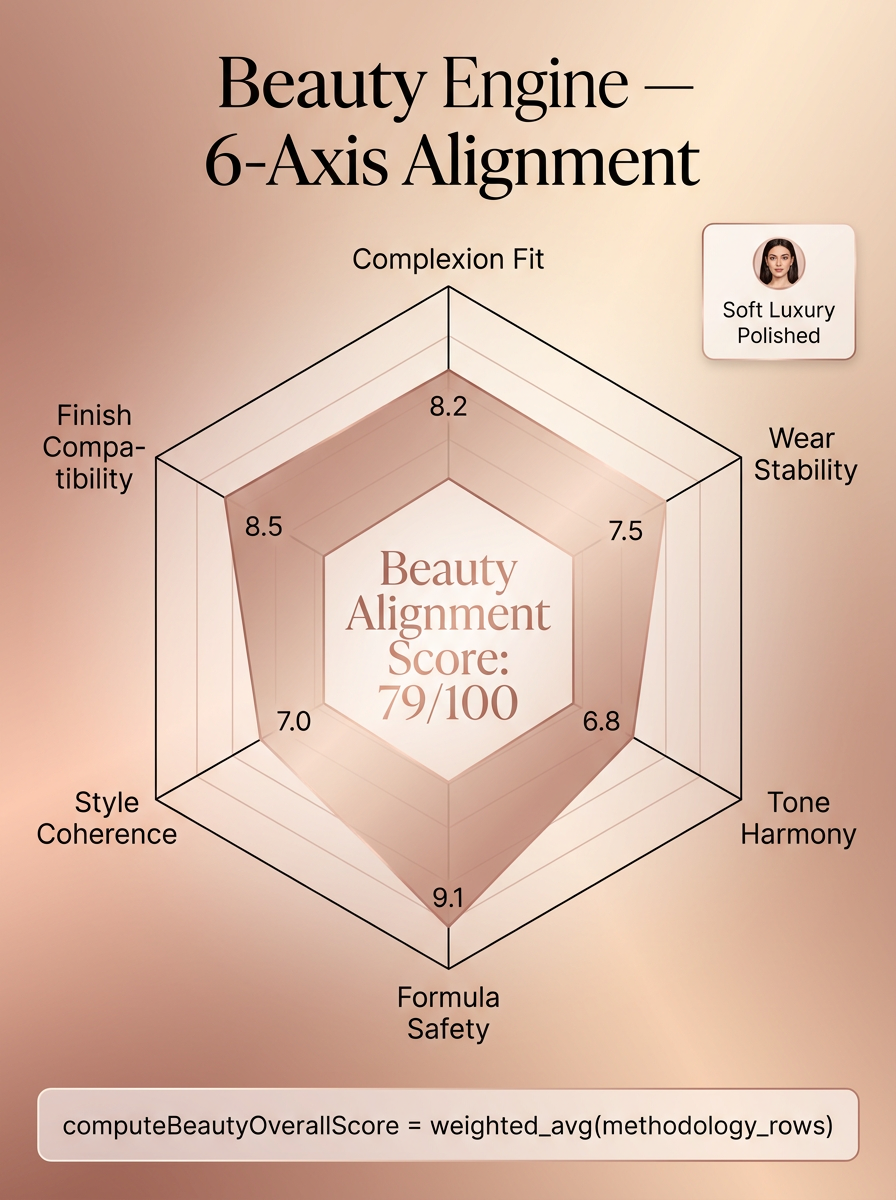
A six-axis alignment score, not a problem score
Beauty is the only engine that doesn't measure problems — it measures alignment between your skin and the look you actually want.
The six axes: Complexion Fit, Wear Stability, Tone Harmony, Formula Safety, Style Coherence, Finish Compatibility. Each is scored 0–10, then averaged with weights into a single Beauty Alignment Score.
Alignment score · archetype card · methodology table · top product matches
Lifestyle Engine
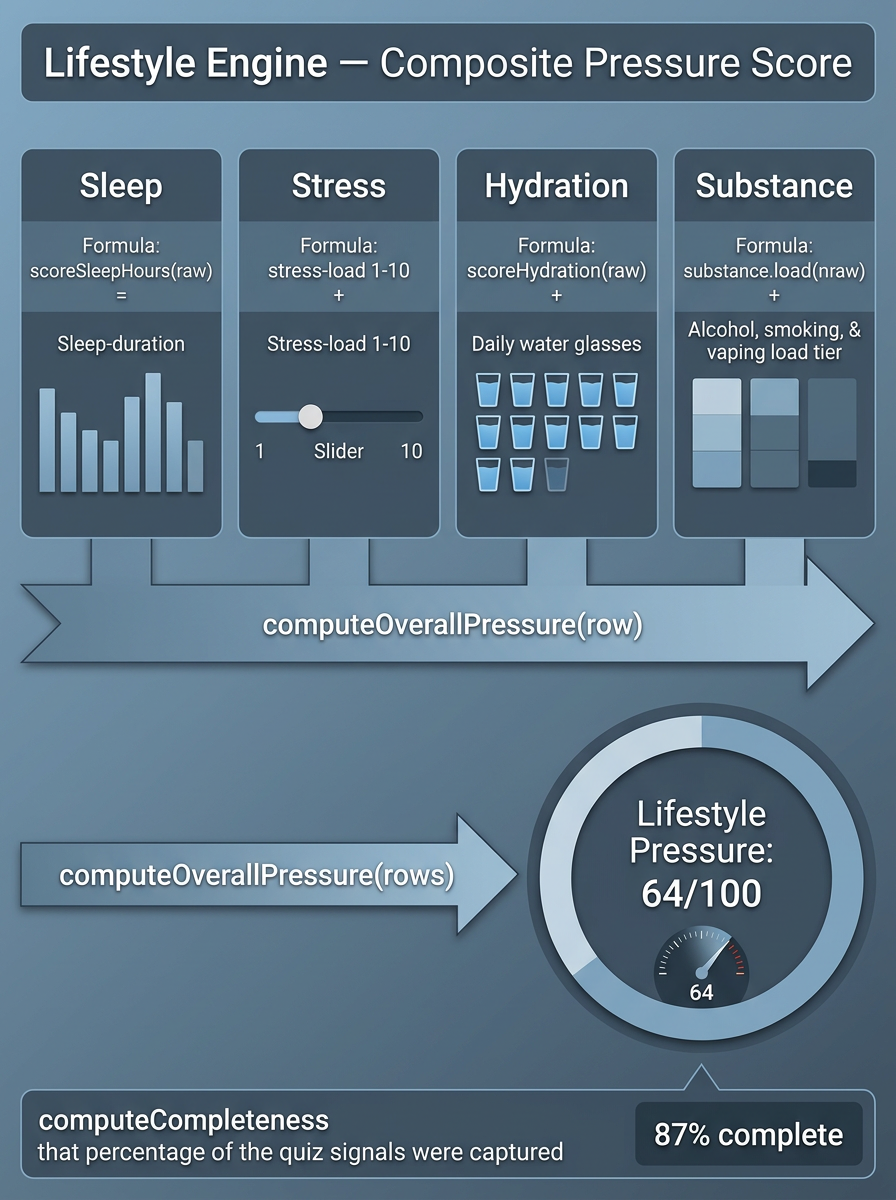
A composite pressure score across sleep, stress, hydration, and habits
Most lifestyle skin advice is anecdotal. The Lifestyle engine refuses to be — it converts your habits into four scored input columns and runs them through a weighted aggregator.
Inputs: Sleep (hours, restorativeness, consistency) · Stress (load + skin response) · Hydration · Substance load (alcohol, smoking, vaping). The output is a single Lifestyle Pressure Score plus a completeness percentage so you know how confident the result is.
Pressure score · completeness % · habit-by-habit breakdown · realistic next-step plan
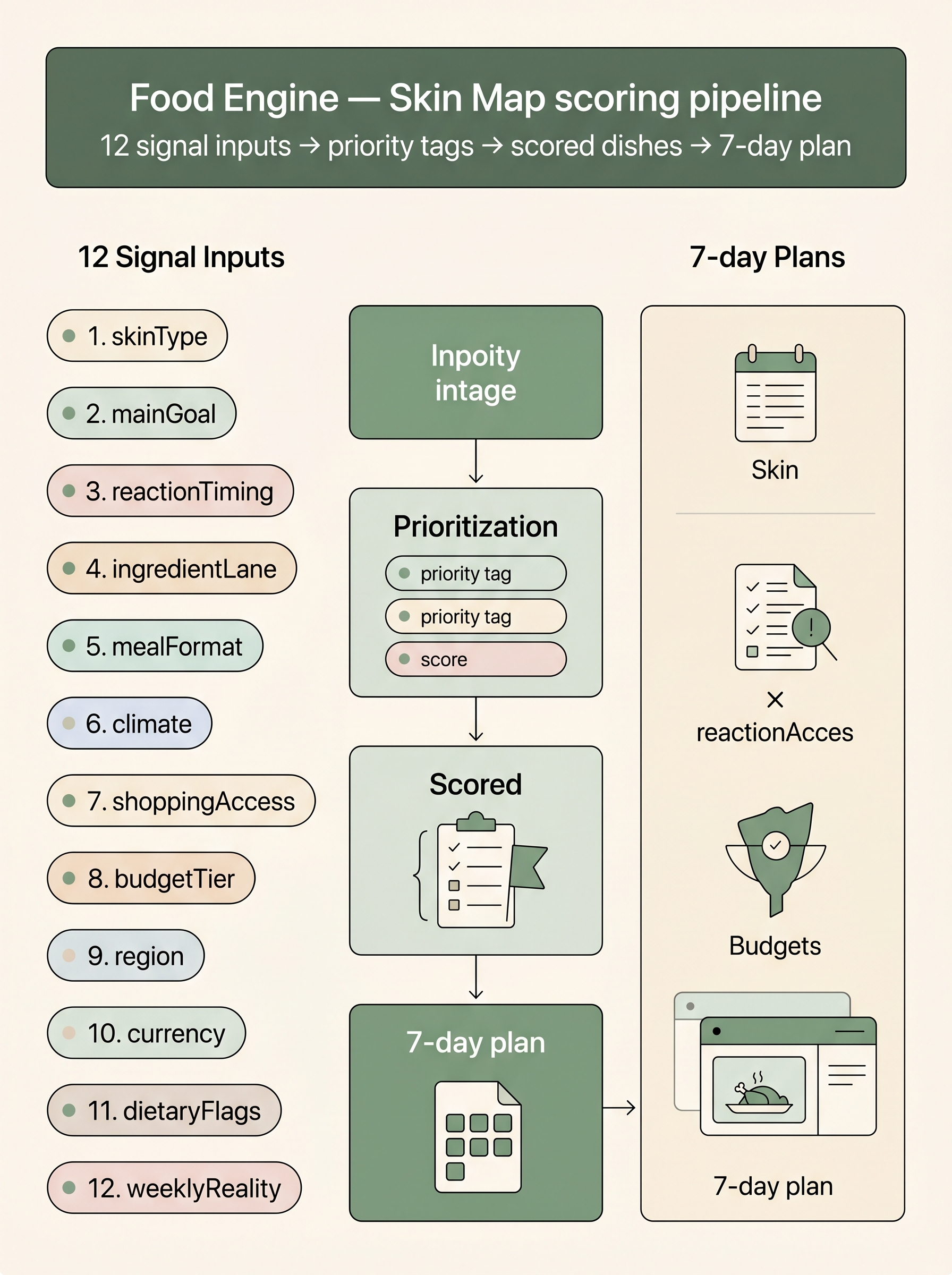
Food Engine
Goal-tag scoring × regional pricing × dietary filters × 7-day meal plan
Food is the only engine that doesn't score severity — it scores recipes against your goal, your budget, your region, and your dietary rules. Thirteen profile signals (skin type, main goal, reaction timing, ingredient lane, meal format, climate, shopping access, budget tier, region, currency, allergies, dietary flags, weekly cooking reality) feed a multi-stage pipeline.
Stage 1 — priority-tag stacks. Each main goal has its own weighted stack: breakouts → clean + lighter + protein + produce + balanced + fresh. Stage 2 — real dish scoring: score = priorityTagMatch × 10 + budgetFit × 4 − triggerPenalty × 6. Stage 3 — filter by budget tier and dietary violations (vegan, vegetarian, halal, kosher, pescatarian, gluten-free, dairy-free) before ranking.
Pricing is regional, not generic. Every dish carries an estimatedPriceUSD plus an estimatedPriceByRegion map across USA, CA, EU, KR, JP, CN, IN. Live FX rates are fetched on report load and cached, so weekly meal-plan totals display in your local currency — convertCurrencySync(usd, userCurrency) — with a static fallback if the API fails.
Top dishes · ingredient cards · 7-day meal plan · grocery list with regional cost · weekly rhythm · watchout list · cross-map suggestions
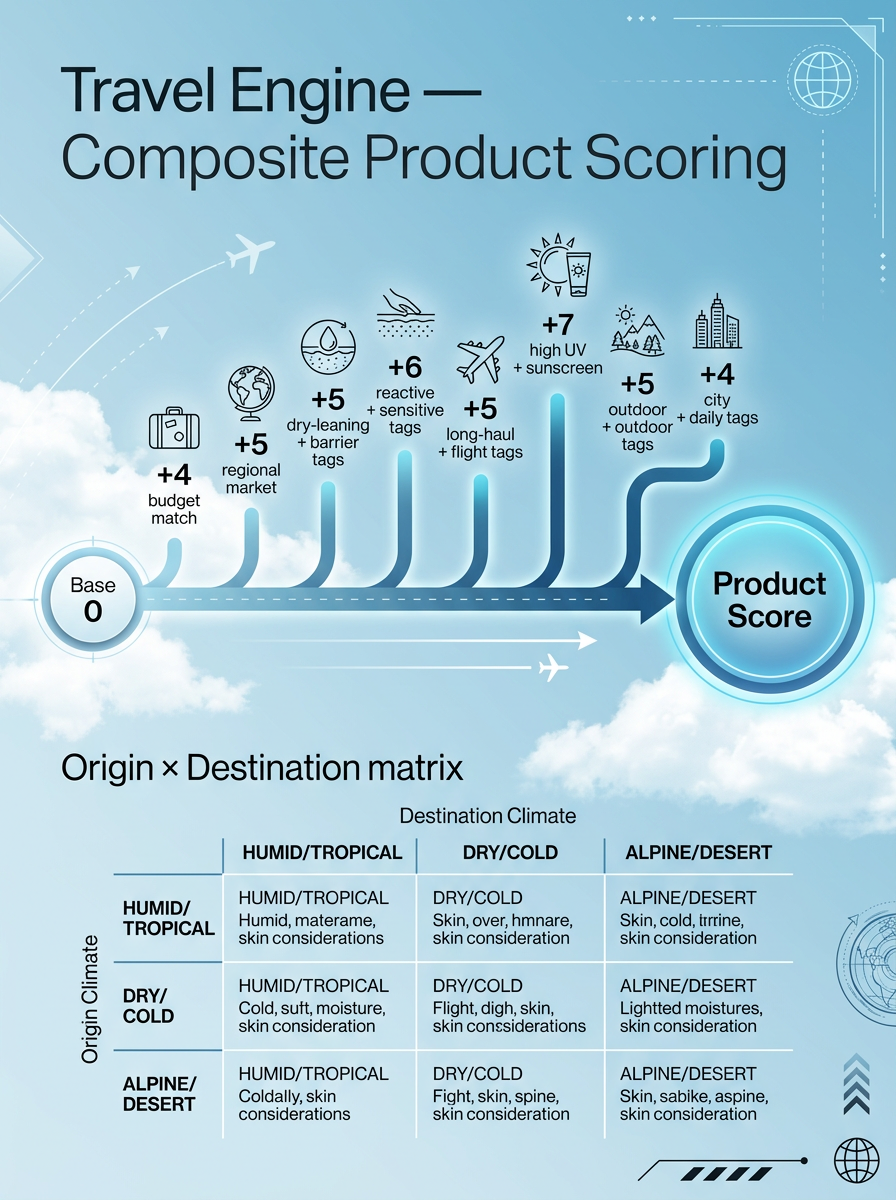
Travel Engine
Additive product scoring × climate-shift matrix × trip phase
The Travel engine recognizes that your skin is in motion — origin climate, cabin air, destination climate, UV index, and trip style all interact.
Product scoring is explicitly additive (every weight is a number you can audit): +4 budget match, +5 regional market, +5 dry-leaning + barrier tags, +6 reactive + sensitive tags, +5 long-haul + flight tags, +7 high-UV + sunscreen, +5 outdoor + outdoor tags, +4 city + daily tags.
Sunscreen during high-UV travel gets the single biggest weight in the system (+7) — because that's where the science is clearest.
Pre-flight, in-flight, and post-landing routines · destination routine · pack-and-buy list
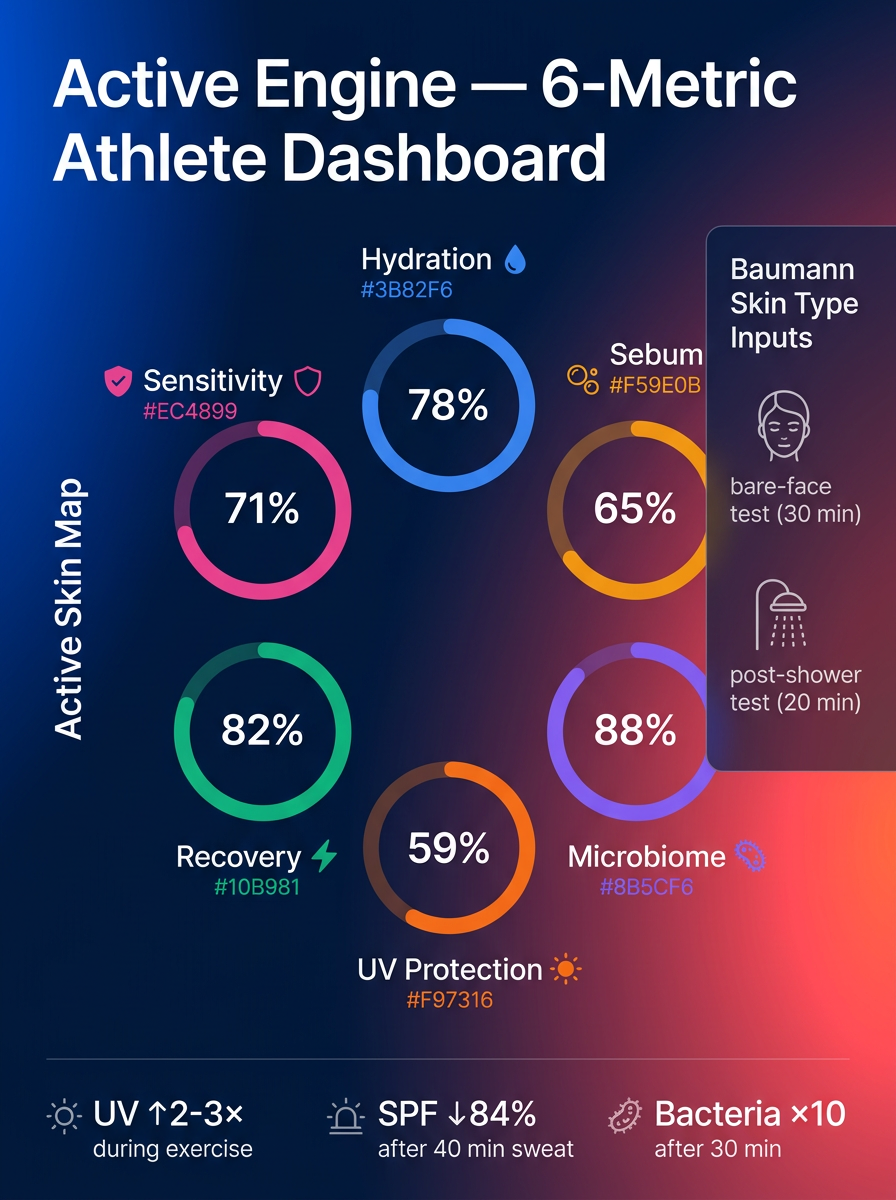
Active Engine
Six athlete-specific metrics anchored in the Baumann Skin Type Indicator
Active skin is different from regular skin — sweat changes pH, vasodilation changes redness, friction changes barrier integrity. The engine starts with the Baumann Skin Type Indicator (a 30-minute bare-face test + a 20-minute post-shower body test) and layers six athlete-specific metrics on top.
The six metrics: Hydration 💧, Sebum Control 🫧, Sensitivity 🛡️, Recovery ⚡, UV Protection ☀️, Microbiome 🦠. Each is grounded in clinical numbers: UV exposure rises 2–3× during outdoor exercise, SPF effectiveness drops 84% after 40 min of sweat, and skin bacteria multiply ×10 within 30 min of post-workout occlusion.
6-metric dashboard · pre/post-workout routines · supplement & ingredient stack · tracker
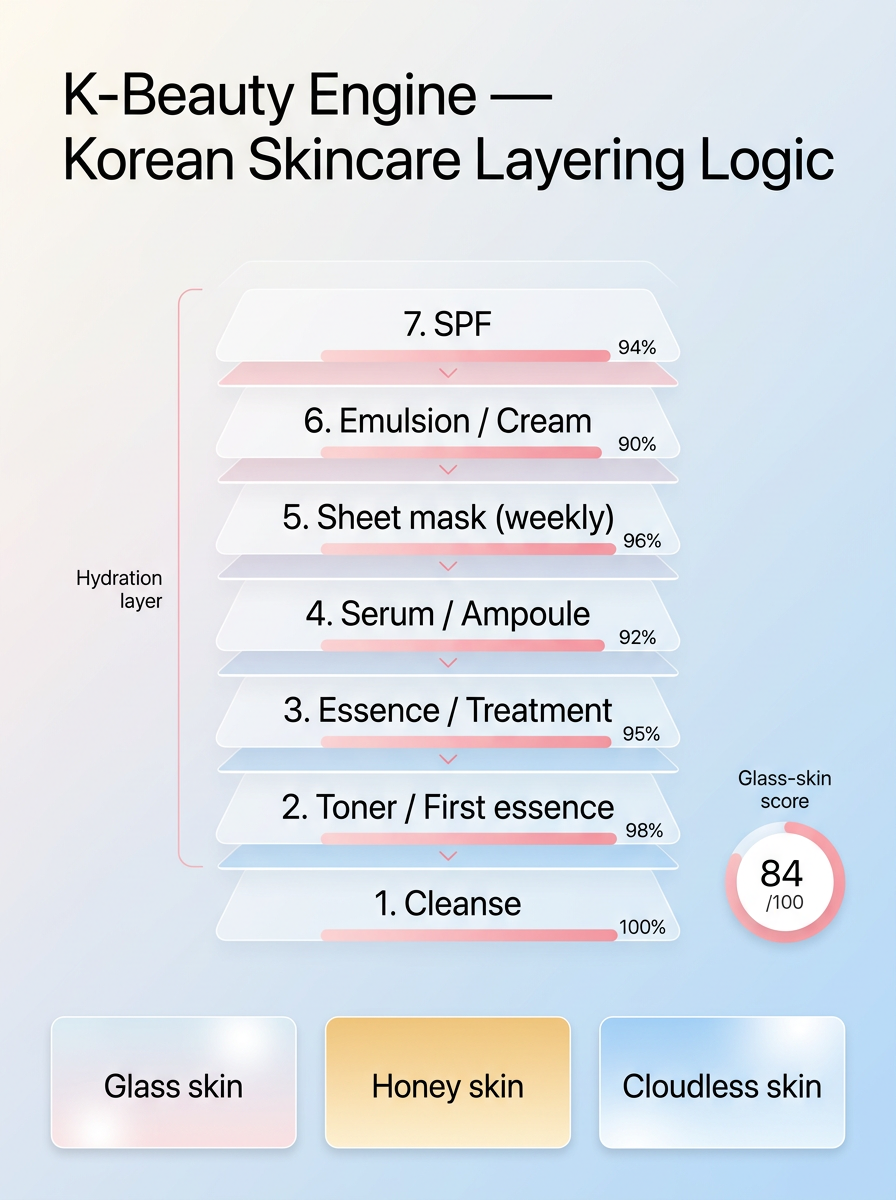
K-Beauty Engine
Seven-layer Korean skincare logic optimized for glass-skin clarity
The K-Beauty engine encodes the classic seven-layer Korean routine (cleanse → toner/first essence → essence → serum/ampoule → sheet mask → emulsion/cream → SPF) and scores each product against layer compatibility — does this serum sit well under that emulsion, does this cream pill under that SPF.
Output archetypes are finish-driven, not problem-driven: Glass skin, Honey skin, Cloudless skin. The engine optimizes for barrier-first hydration with K-beauty texture priorities.
Layered routine · archetype match · K-beauty product picks (Olive Young / YesStyle / StyleKorean)
Glossary — every term, in plain language
The vocabulary used across our quizzes and reports. If a word ever feels confusing inside a Skin Map, you'll find it explained here.
Skin barrier
The outermost protective layer of the skin. When it's healthy, water stays in and irritants stay out.
Stratum corneum
The very top layer of the skin barrier, made of dead skin cells held together by lipids. This is what most 'barrier care' actually targets.
Ceramides
Fat-like molecules that act as the 'mortar' between skin cells. Lower ceramide levels = more dryness, sensitivity, and irritation.
Sebum
The natural oil your skin produces. Too little leads to dryness; too much leads to oily, congested-feeling skin.
TEWL
Trans-Epidermal Water Loss. How fast water evaporates out of your skin. High TEWL = leaky barrier, faster dehydration.
Microbiome
The community of helpful microbes that live on your skin. A balanced microbiome helps calm inflammation and protect the barrier.
pH
A measure of acidity. Healthy skin sits around 4.5–5.5. Cleansers that are too alkaline can disrupt the barrier.
Skin baseline
Your skin's natural behavior with nothing applied: dry, oily, combination, normal, or sensitive.
Dehydrated vs dry skin
Dry skin lacks oil. Dehydrated skin lacks water. You can be oily and dehydrated at the same time.
Comedonal acne
Mostly clogged pores, whiteheads, blackheads. More texture than redness.
Whiteheads (closed comedones)
Clogged pores covered by a thin layer of skin. Bumpy but not red.
Blackheads (open comedones)
Clogged pores exposed to air, oxidizing dark.
Papules
Small red inflamed bumps without a visible head.
Pustules
Inflamed spots with a visible white or yellow center.
Nodular / cystic acne
Deep, painful, under-the-skin lumps. Slower to heal and more likely to scar.
Inflammatory acne
Acne dominated by redness, swelling, and active breakouts (vs just clogged pores).
Hormonal jawline acne
Breakouts that cluster around the chin and jawline and often follow a cyclical pattern.
PIH
Post-Inflammatory Hyperpigmentation. Brown or dark marks left after a breakout heals.
PIE
Post-Inflammatory Erythema. Red or pink marks left after a breakout, more common on lighter skin.
Reactive / barrier-stressed acne
Acne happening on skin that's also sensitive, flushed, or over-treated.
Post-cleanse tightness
That stripped feeling right after washing. Usually a sign the cleanser is too harsh or the barrier is already stressed.
Flaking / xerosis
Visible peeling or dry flakes on the skin surface.
Fine dehydration lines
Tiny crepe-like lines that appear when the skin is low on water (different from true wrinkles).
Reactivity
How easily your skin stings, burns, or flushes when products are applied.
Telangiectasia
Tiny visible blood vessels on the surface of the skin, often on the cheeks or around the nose.
Flushing
Sudden temporary redness, usually triggered by heat, stress, alcohol, or spicy food.
Vasodilation
When blood vessels widen. Causes the warmth and redness you feel after exercise, alcohol, or hot showers.
Hard water
Tap water high in minerals like calcium and magnesium. Can leave residue and stress the barrier.
Indoor heating / AC
Both lower indoor humidity, which speeds up dehydration.
High-glycemic load
Diets high in sugar and refined carbs that can drive inflammation and breakouts.
Gut-skin axis
The two-way connection between digestion and skin. Gut issues can show up as flares within 24–48 hours.
Occlusion
When something blocks the skin (mask, helmet, sweat, heavy product). Can trap heat and cause friction breakouts.
Friction acne (acne mechanica)
Breakouts caused by rubbing, pressure, or repeated contact (helmets, phones, masks).
Cabin-air dehydration
Airplane cabin humidity is around 10–20%, much drier than most homes. Skin loses water faster mid-flight.
Jet lag stress
Disrupted circadian rhythm affects cortisol, which affects oil, inflammation, and recovery.
Climate adaptation gap
When your skin is calibrated to one environment and you suddenly enter another (humid → dry, cold → tropical).
Retinoid / retinol / adapalene
Vitamin A derivatives that speed up skin cell turnover. Powerful but irritating if overused.
AHA
Water-soluble exfoliants like glycolic and lactic acid. Work on the skin surface. Help with dullness, texture, marks.
BHA (salicylic acid)
Oil-soluble exfoliant that goes inside the pore. Best for blackheads and oily skin.
PHA
A gentler, larger-molecule exfoliant. Better for sensitive skin.
Niacinamide
Form of vitamin B3. Calms redness, balances oil, supports the barrier.
Vitamin C
Antioxidant that brightens tone, fades marks, and helps protect against UV damage.
Azelaic acid
Calms redness, helps with acne and pigmentation. Generally well-tolerated by sensitive skin.
Tranexamic acid
Targets stubborn pigmentation, especially melasma.
Benzoyl peroxide
Strong anti-bacterial acne ingredient. Effective but can dry out and bleach fabrics.
Hyaluronic acid
A humectant that binds water to the skin. Hydrates without adding oil.
Severity score
Overall barrier or acne burden. Lower is better.
Congestion score
How much clogged-pore pressure your skin is showing. Lower is better.
Inflammation score
How active, red, and reactive the skin is right now. Lower is better.
Barrier score
How resilient your skin is. Higher is better.
Tone score
How well your skin recovers from marks and discoloration. Higher is better.
Confidence score
How strongly your quiz answers point to one clear pattern.
Match score
How well a recommended product fits your specific quiz answers.
Consistency score
Whether your routine and habits actually align with each other.
Recovery curve
A simple visual showing how clarity tends to build over weeks of consistency.
Rosacea
A long-term condition with persistent redness, flushing, and sometimes visible vessels or bumps. Different from acne.
Eczema / atopic dermatitis
Itchy, dry, inflamed patches caused by a mix of barrier weakness and immune reactivity.
Allergic contact dermatitis
A delayed allergic reaction to a specific ingredient (often fragrance, preservatives, or metals).
Melasma
Patchy, often symmetrical pigmentation, frequently triggered by hormones plus sun.
Glassy / glass-skin finish
The high-shine, dewy K-beauty look. Healthy-looking skin with a wet finish.
Satin finish
A middle ground: not flat-matte, not shiny. Soft polished glow.
Velvet / soft-matte finish
Smooth and powdery without looking dry or cakey.
Soft-focus
A blurring effect where pores and texture look softened rather than sharp.
Clean-girl polish
Minimal-makeup look that still reads 'put together' — usually relies on healthy underlying skin.
About this system
SkinCompass is an educational estimation system, not a clinical diagnostic tool. Each Skin Map's quiz is grounded in dermatology research, and every claim links back to its source inside the report. For medical concerns, please see a licensed dermatologist.
Start with the Barrier Assessment
It's the entry point of the system. After you finish, the platform will route you to the most relevant next Skin Map automatically.
Take the Barrier Assessment →